
Membership Magic: A No-Nonsense Guide to Creating Loyalty Programs for Malaysian Small Businesses
Membership Magic: A No-Nonsense Guide to Creating Loyalty Programs for Malaysian Small Businesses
Small business owners, let’s talk about something that keeps coming up in our CRM implementation conversations - membership programs. While they might seem like the exclusive domain of big corporations, even your neighborhood café or local hardware store can benefit from a well-designed loyalty system. Before you jump onto the membership bandwagon, there are some practical considerations to understand. This guide cuts through the marketing jargon to give you straightforward advice on setting up a program that works for your business and your customers.
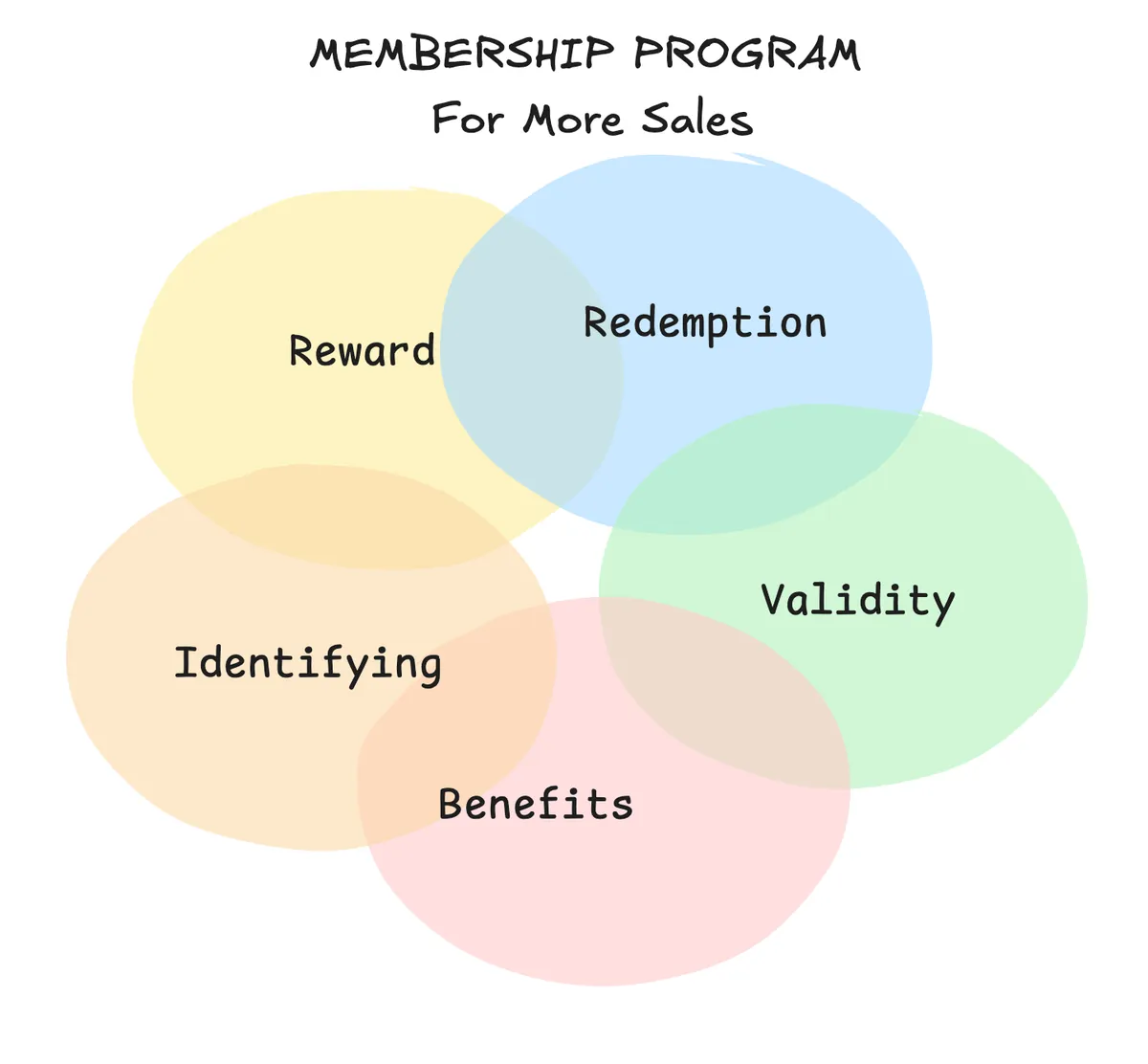
The Five Pillars of Successful Membership Programs
The Reward: How Customers Earn Points
The foundation of any membership program is its reward system - how customers earn points when they spend with you. Most Malaysian businesses follow a straightforward structure, but your specific approach should align with your margins and business model.
Big Pharmacy, for example, gives customers 1 BIG Point for every RM1 spent, with points calculated based on the rounded total amount in a single receipt2. Grab takes a tiered approach, giving regular members 1.5 points for every RM1, Gold members 2.25 points, and Platinum members 3 points per RM16.
For small businesses, simplicity is key. A straightforward “X points per RM1” system is easiest for customers to understand and for your staff to communicate. Consider these practical approaches:
-
For higher-margin businesses: 1 point per RM1 is easy to calculate and communicate
-
For lower-margin businesses: 1 point per RM2 or RM5 might be more sustainable
-
Special occasions: Double or triple points on slow business days or during special promotions
Remember, you’re essentially giving away a percentage of your revenue as a marketing cost, so structure your rewards to remain profitable.
The Redemption: How Points Convert to Value
This is where you decide how customers can use their accumulated points. The redemption rate directly impacts both customer satisfaction and your profit margins.
Major Malaysian companies have varying approaches: AirAsia offers a redemption rate of 125 points for RM18, while AEON requires 400 points for RM13. Grab’s redemption structure is 600 points for RM5, 1,200 points for RM10, and 1,800 points for RM15, regardless of membership tier6.
Important considerations for small businesses:
-
Calculate redemptions on pre-tax amounts: This is crucial because calculating on post-tax amounts (including Malaysia’s typical 8% service tax) effectively increases your cost.
-
Make it simple: Customers should easily understand what their points are worth.
-
Create tiers of redemption: Consider offering better rates for higher redemption amounts to encourage bigger purchases.
-
Allow partial redemptions: Let customers use points for partial payment alongside cash.
A good starting point for small businesses might be 100 points = RM1, which equals a 1% reward rate if you’re giving 1 point per RM1 spent. This makes calculations straightforward for both staff and customers.
Additional Benefits: Beyond Points
While points are the foundation, additional perks can significantly enhance the perceived value of your membership program without necessarily costing more.
Effective additional benefits include:
-
Birthday rewards: A free item or special discount during the customer’s birthday month (Maybank offers 2x points during birthday months4)
-
Early access: Let members shop new collections or menu items before the general public
-
Member-only events: Special workshops, tastings, or demonstrations
-
Dedicated service: Priority queuing or service for members
-
Partner benefits: Cross-promotions with complementary local businesses
These value-adds often create more loyalty than the points themselves, as they make customers feel special and recognized.
Points Validity: The Expiry Question
At some point, you need to decide if and when points expire. This has financial implications for your business and psychological impact on customers.
Maybank’s TreatsPoints are valid for 3 years, with points earned in a particular month expiring at the end of the third year5. Grab takes a different approach - points never expire as long as customers make at least one transaction every 3 months6.
For small businesses, consider these options:
-
Medium-term expiry (1-2 years): Balances financial liability with customer satisfaction
-
Activity-based expiry: Points remain valid as long as the account shows activity every 6-12 months
-
Seasonal cleanup: All points expire on a specific date yearly, with ample notice to customers
Whatever you choose, be transparent about your expiry policy from the start. Surprising customers with unexpected point expirations is a quick way to generate negative sentiment.
Customer Identification: Keep It Simple
The membership identifier is crucial - it needs to be unique yet easy for customers to remember and for your staff to find in the system:
- Phone Numbers (Recommended)
- Apps
- Membership Cards
In Malaysia, phone numbers work exceptionally well as identifiers because:
-
Nearly everyone has a mobile number
-
Most people remember their own number
-
It doesn’t expose sensitive personal information
-
It’s unique to each customer
While app-based systems are trending, they represent a significant investment that many small businesses can’t justify. Our experience shows that fewer than 30% of customers will download and regularly use a small business’s app. Instead, consider:
-
SMS-based systems: Send accumulation and redemption details via text
-
Point-of-sale lookup: Staff can easily search by phone number
-
Physical cards with QR codes: For customers who prefer something tangible
-
Integration with WhatsApp: Leverage a platform most Malaysians already use daily
Finally there is what is considered a classical method is to give a membership card and use the membership card id. Unfortunately no one remembers the cards or keeps the cards these days. The initial investment of printing the cards (typically with a MOQ) is gone after the first day of giving the card to the customer.
The best approach is one that puts the responsibility on your staff rather than customers - make identification frictionless at the point of sale.
Making the Numbers Work: Profitability Calculations
Before launching your program, understand exactly how it will impact your bottom line. Here’s a straightforward way to calculate the break-even point for your membership program.
For Product-Based Businesses
Assuming:
-
50% gross margin (common for retail products)
-
RM30 customer acquisition cost
-
5% reward rate (points value)
Break-even calculation: RM30 ÷ (0.50 - 0.05) = RM66.67
This means a customer needs to spend at least RM66.67 before your loyalty program becomes profitable. Any spending beyond this amount contributes to your bottom line.
For Service-Based Businesses
Assuming:
-
20% gross margin (common for services)
-
RM30 customer acquisition cost
-
5% reward rate (points value)
Break-even calculation: RM30 ÷ (0.20 - 0.05) = RM200
Service businesses with thinner margins need customers to spend significantly more to break even on a loyalty program investment.
Remember that these calculations assume the customer acquisition cost is fully allocated to the membership program. In reality, you’d be acquiring customers anyway, so the incremental cost of the membership program is often lower than the full customer acquisition cost.
Comparison of Major Malaysian Loyalty Programs
Phase 1: Strategic Warehouse Placement
Frequently Asked Questions
Will a membership program increase my sales?
In most cases, membership programs don’t directly drive new sales. Customers rarely make purchases solely because of membership benefits. However, they do encourage:
-
Upselling: Customers are more likely to add items to reach point thresholds or qualify for promotions
-
Repeat business: The psychological effect of accumulated points creates a “switching cost” that keeps customers coming back
-
Higher average transaction value: Members typically spend 12-18% more per transaction than non-members
Think of it this way: a customer won’t buy a RM24 pen just to get RM2.40 in points if the membership costs RM10. But they might choose your store over a competitor’s when they need a pen, and they might buy additional stationery items to maximize their point earnings.
How soon will I see ROI from my membership program?
Most small businesses see a positive return within 6-9 months. The key metrics to monitor are:
-
Increase in repeat customer rate
-
Change in average transaction value
-
Frequency of visits from members vs. non-members
Case Study Breakthrough: Bradshaw International reduced Walmart DSDC errors by 72% using a WMS with Pick-from-Light integration — an accuracy gain that depends as much on warehouse team training as on the software itself.
Future-Proofing Your Network
Emerging Trends:
- Blockchain Traceability
- Farm-to-fork visibility for perishables
- 18-second recall identification vs 6.5 days traditionally2
- Robotic Process Automation
- Auto-replenishment bots in freezer warehouses
- 63% faster cycle counts in -25°C environments8
- Sustainability Integration
- Carbon tracking per warehouse
- “Green routing” algorithms reducing fuel use
Your Action Plan for Multi Warehouse Success
- Audit Current State Map SKU velocities and customer locations using Omniful’s Analytics2
- Start Small Pilot with 2 warehouses using Katana’s Centralized Inventory tools6
- Phase in Automation Begin with mobile scanning before full WMS rollout
- Train & Iterate Use AR simulations for freezer warehouse staff
“The companies winning in multi warehouse management aren’t those with the most locations—they’re those with the smartest centralized control systems.” – enVista Logistics Report 2025
Ready to transform your scattered warehouses into a synchronized network? Book a demo with ShipBob’s experts or download our free Multi Warehouse ROI Calculator to model your potential savings.