
Cold Room Temperature Monitoring System with HACCP-Ready Records
Every chiller and freezer on one screen, an SMS the moment a room drifts out of range, and the monitoring, corrective-action and calibration records your HACCP auditor asks for, without the clipboard.
A Cold Room Fails at 2am. Who Finds Out, and When?
In most Malaysian cold rooms the answer is "the morning shift", from a thermometer reading written onto a clipboard. By then a freezer that tripped overnight has been warming for hours, and the decision to hold, release or discard the stock is a guess.
UpStore's Cold Room Monitoring System (CRMS) replaces the clipboard with wireless temperature sensors that report every five minutes, alarms that reach the right people by SMS and email, and a record of every reading, deviation and corrective action. It was built with a Malaysian food manufacturer working towards HACCP certification under MS 1480:2019, and the records it keeps are the ones that audit calls for.
Sound Familiar?
What we hear from QA managers, plant engineers and cold store operators.
"The temperature log was filled in at the end of the shift."
Four neat readings a day, all in the same handwriting and the same pen. An auditor can spot a back-filled log sheet straight away, and it tells you nothing about the hours in between.
"The compressor tripped on Saturday night. We found out on Monday."
A whole room of frozen stock written off, and nobody can say exactly when the temperature went out of range, so nobody can say what was safe to keep.
"The auditor wants 12 months of records and every corrective action."
The readings are in one binder, the deviations are in WhatsApp, and the corrective actions were never written down. Pulling the evidence together takes a week.
"When were these thermometers last calibrated?"
The certificates are somewhere in someone's email. Nobody knows which sensor is due, or whether the lab's accredited range even covers −18°C.
How the Cold Room Monitoring System Works
From a sensor reading to a signed audit report, with nothing written by hand.
-
Step 1
Sensors report every 5 minutes
Wireless temperature sensors in each chiller and freezer send their readings securely over HTTPS. If the network drops, they buffer the readings and backfill them later.
-
Step 2
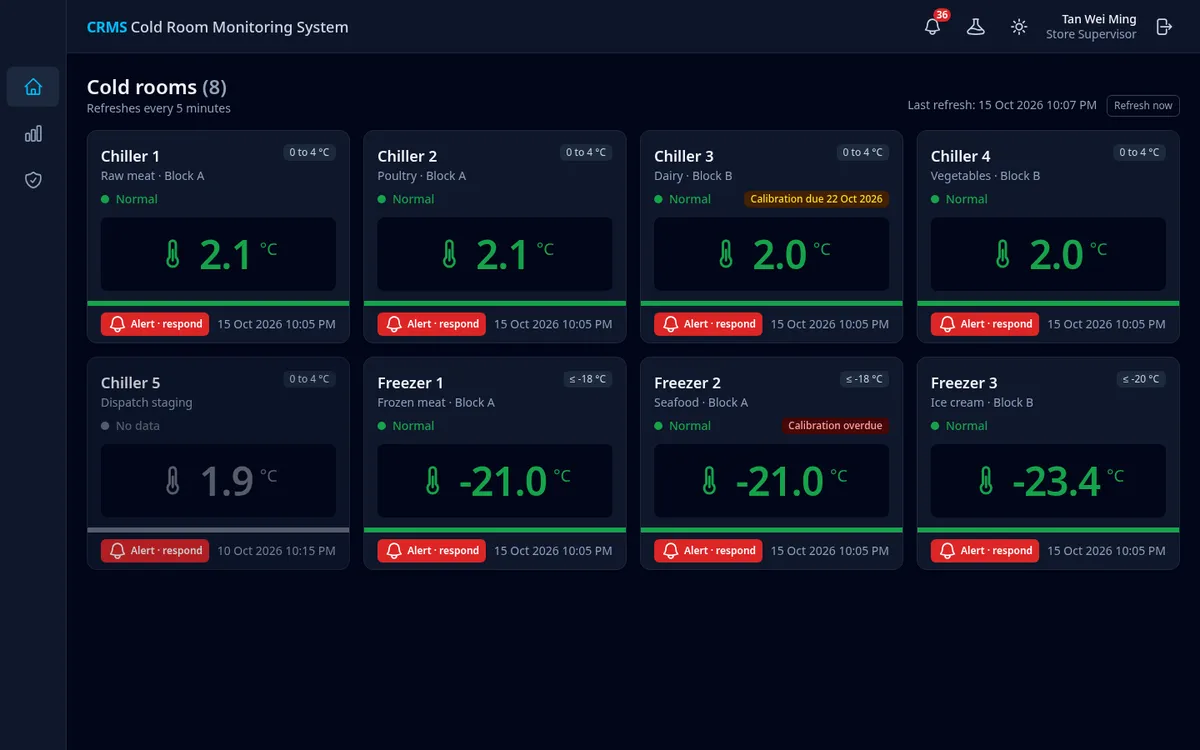
One dashboard, four colours
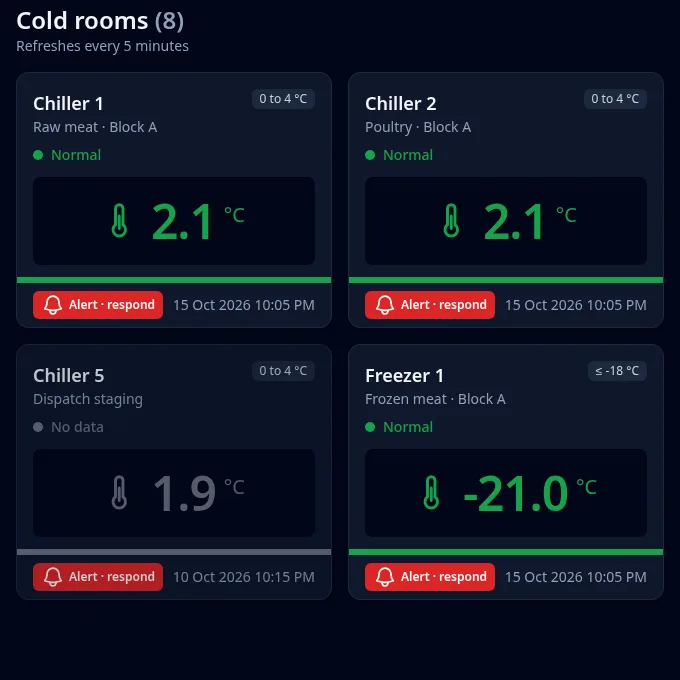
Each room is a card: green in range, yellow close to a limit, red out of range, grey offline. It is readable from across the room on a wall screen.
-
Step 3
Alarms that mean something
An alarm is only raised if a room stays out of range past its delay, so an open door doesn't set it off. A sensor that goes silent raises an alarm as well.
-
Step 4
SMS & email to the right people
The QA team, the engineer on call and the manager, plus any outside contacts you add. Every message sent is logged.
-
Step 5
Corrective action closes the alarm
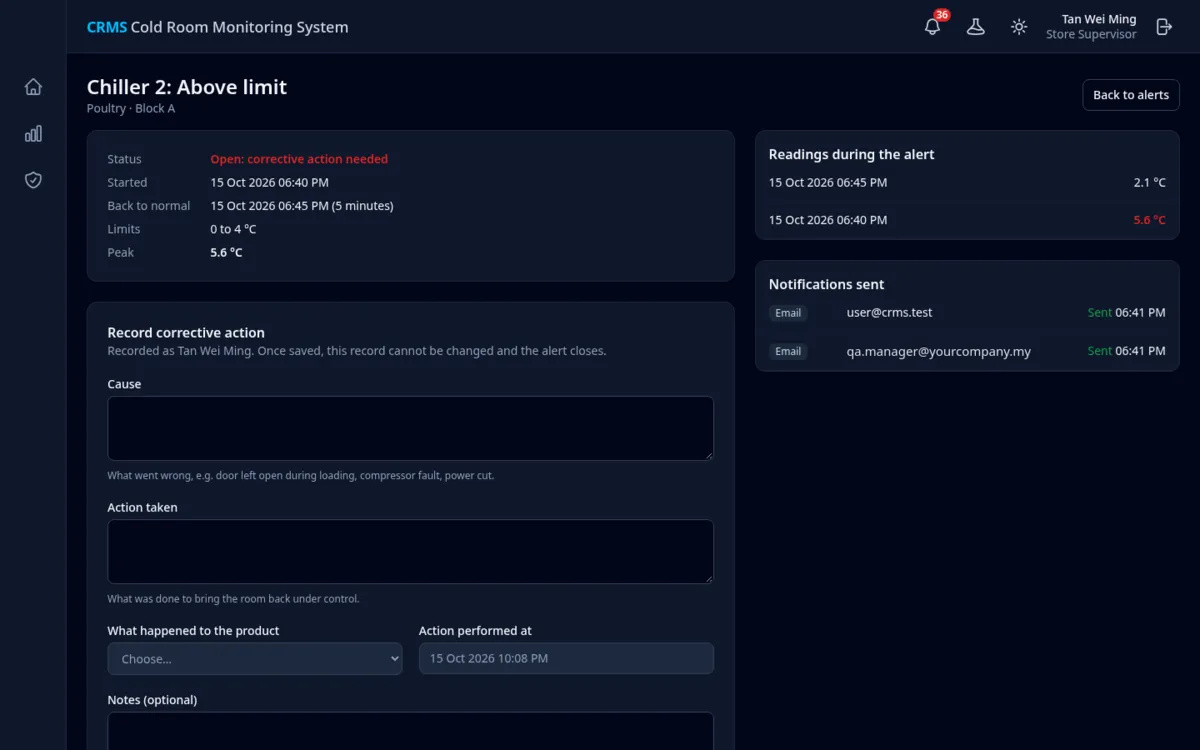
An alarm can only be closed by recording the cause, the action taken, what happened to the product (hold, discard or release) and who did it.
-
Step 6
Report, sign, file
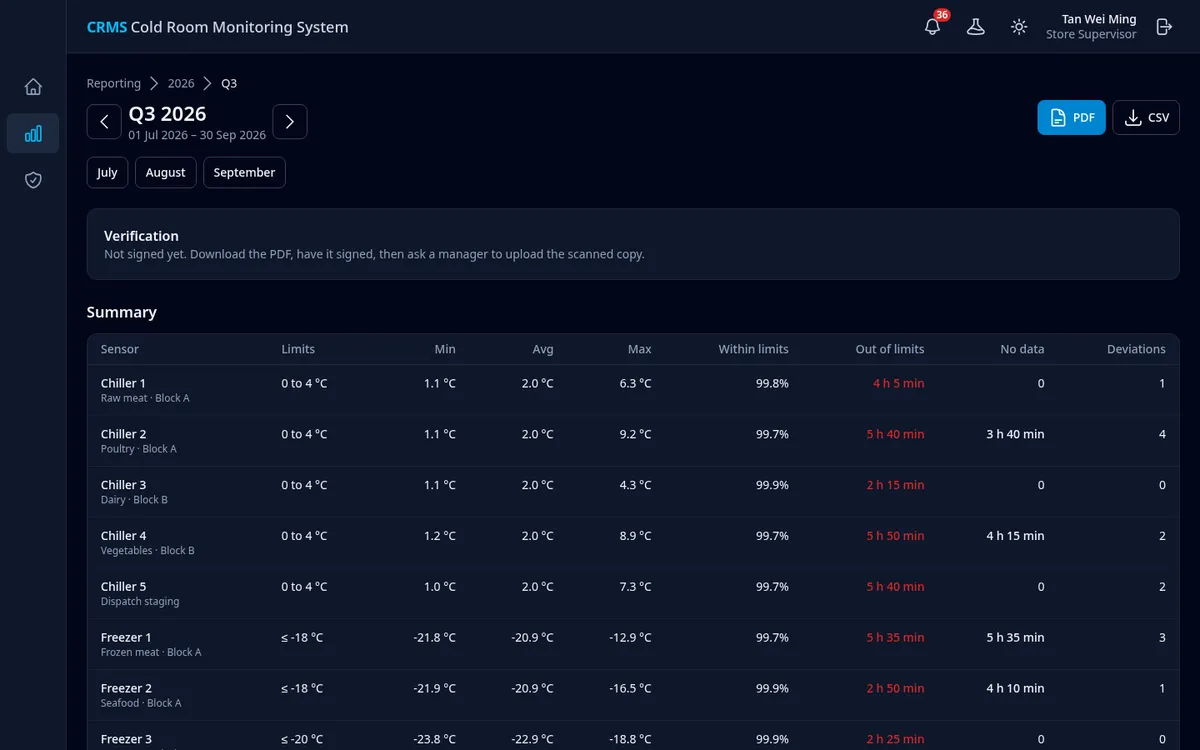
Monthly, quarterly or yearly reports as PDF or CSV. A manager signs off, and the signed copy is uploaded and stored against that period.
See It in Action
Built Around HACCP and MS 1480:2019
HACCP certification is awarded to your food business, not to a piece of software. What a monitoring system can do is make sure the evidence for your cold room critical control points is complete, untampered and quick to produce on audit day.
| HACCP principle | What the auditor looks for | How the system provides it |
|---|---|---|
| 4. Monitoring | Continuous, timestamped temperature readings for every cold room CCP | Readings every 5 minutes, timestamped at the sensor, stored per room with the limits in force at that moment |
| 5. Corrective action | What went wrong, what was done and what happened to the product | An alarm cannot be closed without a corrective action record: cause, action, product disposition, by whom and when |
| 6. Verification | Periodic management review, and calibrated measuring equipment | Signed periodic reports stored against each period; a calibration register with SAMM / ISO/IEC 17025 certificates and overdue flags |
| 7. Record keeping | Records that are complete, attributable and not altered after the fact | Readings can't be edited or deleted; every change to limits, users or settings goes into an audit trail; records are kept indefinitely |
HACCP certification in Malaysia: the cold room records auditors check →
Features
🌡️ Per-room temperature limits
Chiller (0–4°C) and freezer (−18°C or colder) presets, or a custom range per room to match your HACCP plan.
🟡 Early warning band
A room turns yellow as it nears a limit, so the team can act before it becomes a deviation.
⏱️ Alarm delay
Set how long a room may be out of range before an alarm is raised. Loading-bay door openings don't cause alarm fatigue.
📡 Offline detection
A sensor that stops reporting is treated as a deviation and raises its own alarm. A dead battery can't hide a warm room.
📱 SMS & email alerts
Choose per user who gets SMS, email or both, plus outside recipients such as your refrigeration contractor.
📝 Corrective action records
Cause, action taken and product disposition (no product affected, hold, discard, released after assessment), each attributed to a named person.
🔧 Calibration register
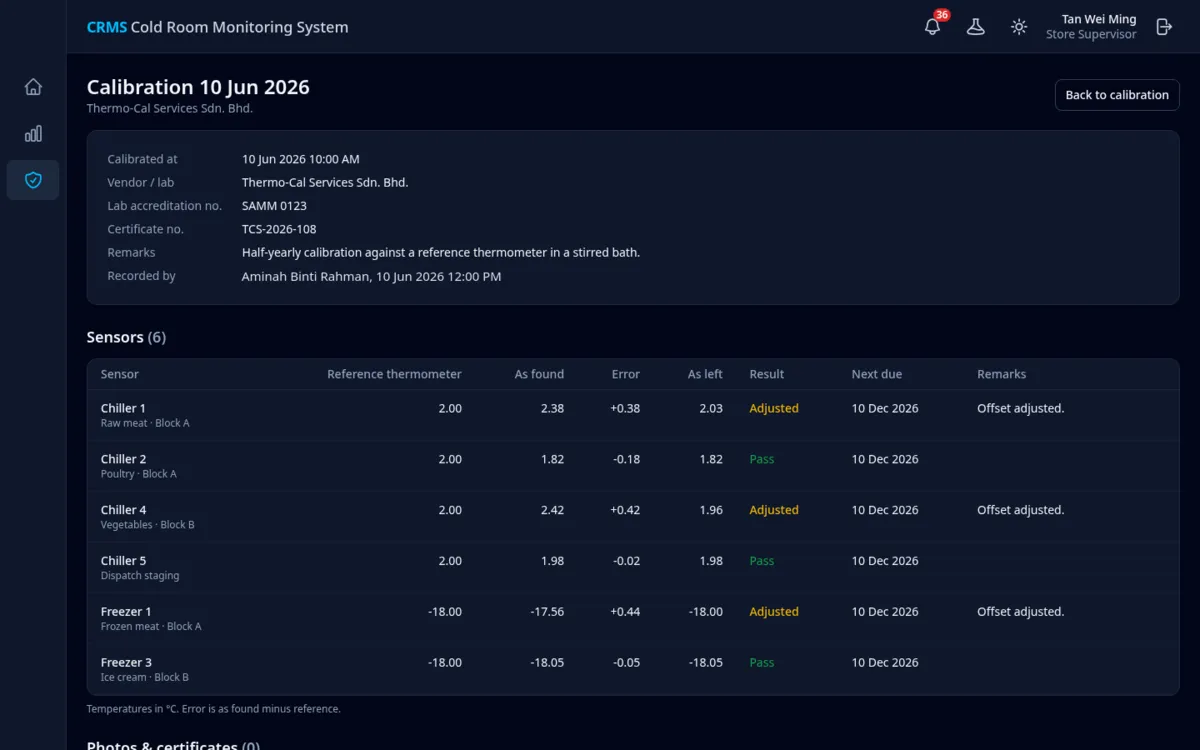
As-found and as-left readings for each sensor, lab accreditation and certificate numbers, photos, next due date, and CSV export.
📊 Reports
Last 365 days, quarter or month, or drill down Year › Quarter › Month. Min, max, average and minutes out of range, exported to PDF and CSV.
🔒 Tamper-proof audit trail
Readings are locked once recorded. Changes to limits, users and settings are logged with who, when and the old and new values.
One Vendor: System, Sensors, Installation and Calibration
You don't have to coordinate a software company, a sensor supplier, an electrician and a calibration lab. We handle all of it: we survey the site, supply and install the wireless temperature sensors, commission each room, and schedule every calibration after that. You have one contact and one contract.
- Accuracy of ±0.5°C or better, suitable for chiller and freezer critical control points
- Local buffering: readings taken during a network or power outage are stored and uploaded afterwards, so your records have no gaps
- Open protocol: the system takes data from any sensor or gateway that can send HTTPS, so you aren't locked in to one brand, and existing Modbus devices can connect through a gateway
- Lab calibration every 6 or 12 months, at the interval your HACCP plan chooses. We collect the sensors and send them to a SAMM-accredited ISO/IEC 17025 laboratory, whose accredited range covers −20°C to +10°C, to be calibrated in a controlled environment. Each sensor comes back with its own calibration certificate, which we file in the system.
- No monitoring gap during calibration: we install calibrated spare sensors before the originals are taken to the lab, so every cold room keeps reporting throughout.
- Browser-based: works on a wall screen, a desktop or a phone, with nothing to install
Who It's For
Food Manufacturers
Raw material chillers, finished-goods freezers and the evidence for MS 1480 or GMP audits.
Cold Stores & 3PL
Prove to every customer that their stock stayed in range, room by room.
Central Kitchens & F&B Chains
Walk-in chillers across the central kitchen and outlets, all on one dashboard.
Meat, Seafood & Dairy Traders
High-value frozen stock where one overnight failure costs more than the whole system.
Cold Room Temperature Monitoring FAQ
What temperature should a cold room be in Malaysia?
Most HACCP plans set chillers at 0°C to 4°C and freezers at −18°C or colder. Those are the two presets in our system, and you can set a custom range for any room your HACCP plan treats differently, such as a 2–8°C pharma room or a −25°C ice-cream store.
Is the system HACCP certified?
No software or sensor is "HACCP certified". HACCP certification (MS 1480:2019 in Malaysia) is awarded to your food business and its HACCP system. What the monitoring system does is produce the evidence your auditor asks for: continuous monitoring records, corrective actions, verification sign-offs and sensor calibration certificates.
What is the difference between a temperature data logger and a monitoring system?
A data logger records readings that you download later, so you find out about a failed compressor after the stock is already lost. A monitoring system sends every reading as it is taken, raises an SMS or email alarm while there is still time to act, and keeps the corrective action and report alongside the readings.
What happens if the Wi-Fi or power goes down?
The sensors store readings locally and send them when the connection comes back, so there are no gaps in your records. If a sensor goes silent for longer than its offline limit, which is 15 minutes by default, the system raises an offline alarm, because missing data is a deviation in its own right.
Will opening the cold room door trigger false alarms?
No. A sensor card turns red the moment a reading goes out of range, but the alarm is only sent if the reading stays out of range for the delay you set, which is 15 minutes by default. A door left open for a delivery shows on screen, but an actual equipment failure is what wakes someone up.
Who calibrates the temperature sensors, and how often?
We do. You choose the interval to match your HACCP plan, every 6 months or every 12 months, and we schedule each calibration for you. The sensors are taken to a SAMM-accredited (ISO/IEC 17025) laboratory, where they are measured and calibrated in a controlled environment against reference standards, and each one comes back with a calibration certificate. Before any sensor leaves site, we swap in a calibrated spare, so your cold rooms are never unmonitored. The as-found and as-left readings, certificate number and photos are filed against each sensor, and the dashboard flags any sensor that is coming due.
Do we need separate vendors for the software, sensors and installation?
No. We are a single vendor for the whole system: the monitoring software, the sensors, installation and commissioning, and scheduled calibration. You have one contact and one contract, and nobody can blame another vendor when an alarm goes off at 2am.
Can we use our existing temperature sensors?
Often, yes. The system takes readings over an open HTTPS protocol, so any sensor or gateway that can post data, or a small gateway that converts Modbus, can feed it. We will check your hardware during the site survey. For new sites we supply, install and commission the sensors ourselves.
How long are the temperature records kept?
Indefinitely, unless your certification body confirms a shorter retention period. Readings cannot be edited or deleted, not even by a manager, and every change to a sensor limit or user account is recorded in an audit trail, so the record your auditor sees is the record that was made.
Also Managing the Stock Inside the Cold Room?
The monitoring system works on its own. If you also need FIFO/FEFO, batch and expiry tracking or break-bulk repacking, see our warehouse management system for cold rooms.
How Long Could Your Freezer Fail Before Anyone Knew?
Book a site survey. We will walk your cold rooms, check any sensors you already have, and show you the dashboard, alarms and audit report running on demo data.