
HACCP Certification in Malaysia: Getting Your Cold Room Records Audit-Ready

On audit day, the cold room itself is rarely the problem. The chillers hold 2°C, the freezers hold −20°C, and the auditor can see that with their own thermometer. What they can’t see is the last twelve months. For that, they ask for your records. That’s where many Malaysian food businesses lose marks on the way to HACCP certification.
If you run the warehouse, you probably don’t own the HACCP plan. The QA team or a consultant writes it. But the cold room records that prove the plan works are produced on your floor, by your team, every shift. This guide covers what those records are, what an MS 1480:2019 auditor looks for in each, and how to spot the gaps before they do.
HACCP certification in Malaysia, in two minutes
MS 1480:2019 is the Malaysian Standard for food safety based on the Hazard Analysis and Critical Control Point (HACCP) system. It follows the internationally recognised Codex Alimentarius HACCP principles. In Malaysia you can be certified against it by the Ministry of Health, through its Food Safety and Quality Division, or by an accredited third-party certification body.
Two points matter for a warehouse manager:
- HACCP certifies your business, not your equipment. No cold room, sensor or software is “HACCP certified”. The auditor certifies that your system controls food safety hazards, and your records are the evidence.
- Temperature is usually a control point. For chilled and frozen food, cold storage is typically either a critical control point (CCP) or a closely monitored prerequisite programme in the HACCP plan. Either way, the auditor expects defined limits, monitoring, corrective actions and verification.
The five cold room records auditors ask for

1. Critical limits, written down for each room
Before the auditor looks at a single reading, they check what the readings are supposed to be. Every chiller and freezer needs a documented limit that matches your HACCP plan. Typical limits are 0°C to 4°C for chillers and −18°C or colder for freezers, but your HACCP team sets the final numbers. A pharma room or an ice-cream store may be different.
Common gap: the HACCP plan says 0–4°C, but the sign on the chiller door says 0–5°C, and the log sheet has no limit printed at all. The auditor will ask which one your staff actually work to.
2. Monitoring records: continuous, attributable, believable
This is the big one. HACCP principle 4 requires you to monitor each control point at a defined frequency and to record who did it. Auditors look at three things:
- Frequency. Did monitoring happen as often as the plan says? Four readings a day on paper, or every few minutes from a sensor?
- Coverage. What about nights, weekends and public holidays? A log sheet that stops at 6pm on Friday and resumes at 8am on Monday covers less than half of the week.
- Credibility. Experienced auditors spot back-filled logs straight away: the same pen, the same handwriting, suspiciously round numbers, and a column of 2.0°C readings that never vary.
Common gap: the readings are complete on the days the supervisor was in, and blank on the days they weren’t.
3. Deviations and corrective actions
Every cold room drifts out of range at some point. A compressor trips, a door is left open during loading, or there’s a power cut. The auditor doesn’t expect zero deviations. They expect that every deviation has a corrective action record (HACCP principle 5) that answers:
- What went wrong (the cause)
- What was done to bring the room back under control
- What happened to the product: no product affected, held for assessment, discarded, or released after assessment
- Who did it, and when
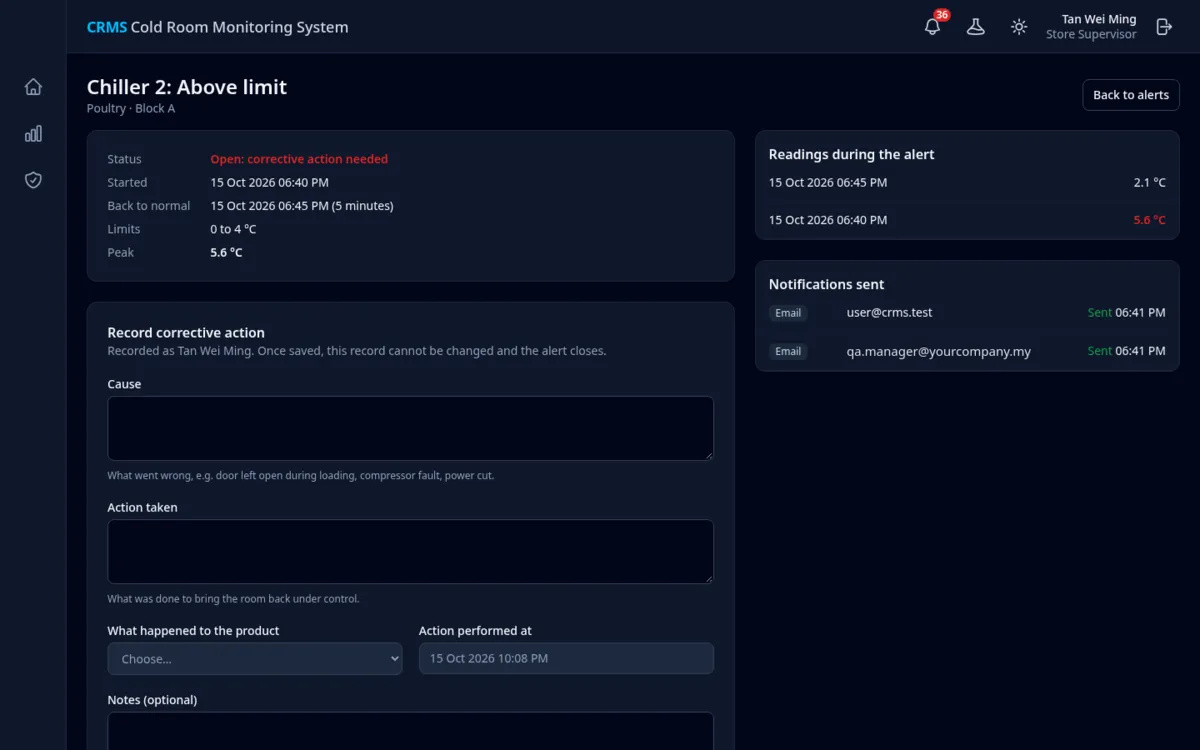
Common gap: the log sheet shows 9°C at 7am, and then nothing. The engineer fixed the compressor, and someone moved the stock to another chiller, but none of it was written down. The fix happened over WhatsApp, and the record simply doesn’t exist.
4. Verification: sign-offs and calibration
HACCP principle 6 asks how you know the monitoring itself is working. For a cold room, that means two things:
- Management review. A responsible person, often the warehouse or QA manager, reviews the temperature records periodically and signs them off. An unsigned binder of log sheets is monitoring without verification.
- Calibrated instruments. Every thermometer or sensor used for monitoring must be calibrated at a defined interval, commonly every six to twelve months, against a reference traceable to national standards. In Malaysia, that means a laboratory accredited by SAMM (the Skim Akreditasi Makmal Malaysia, the national ISO/IEC 17025 scheme). Check that the lab’s accredited range covers your freezer temperatures, not just room temperature.
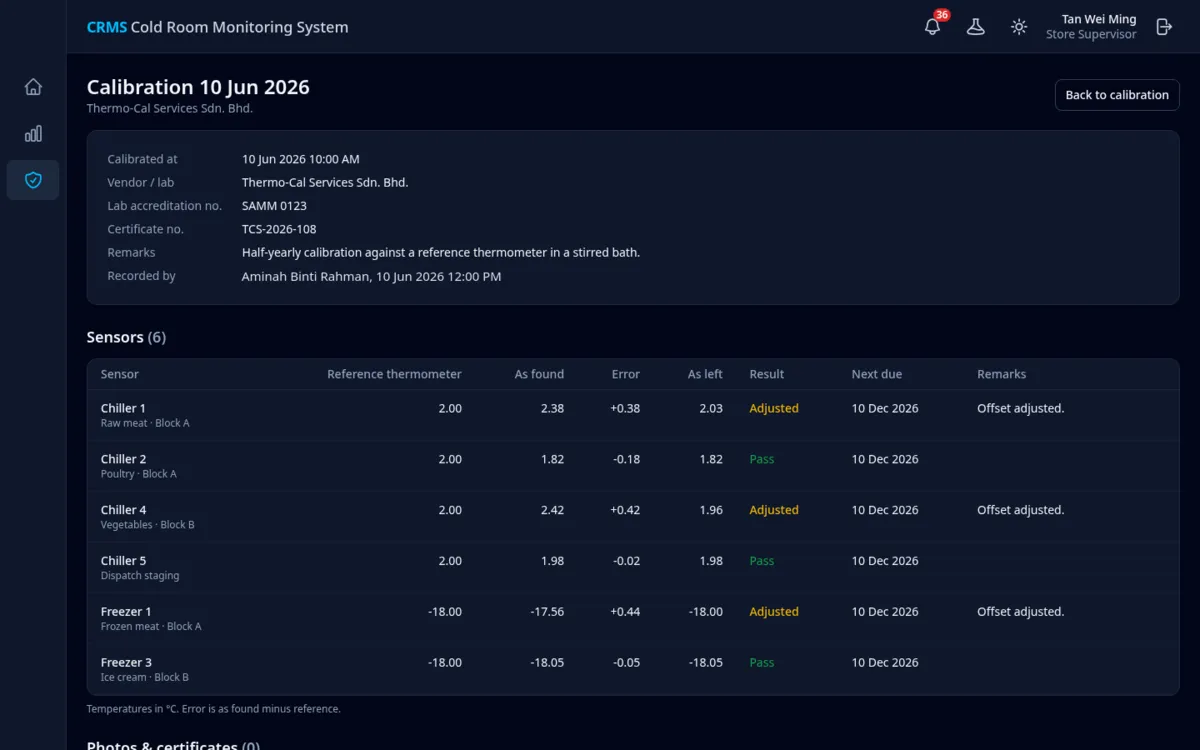
Common gap: the calibration certificate exists, but it’s in someone’s email. It covers three of your five sensors, and it expired two months ago.
5. Record keeping: complete, retrievable, unaltered
HACCP principle 7 is about the records themselves. The auditor will pick a random date, sometimes months back, and ask to see the readings, any deviation, and the corrective action for that day. They are checking that:
- Records are kept for the retention period your HACCP plan or certification body requires
- You can retrieve them quickly, in minutes rather than days
- They haven’t been altered after the fact. On paper that means corrections are crossed out and initialled, not overwritten or whited out.
Audit-readiness at a glance
| Record | What the auditor checks | Red flag |
|---|---|---|
| Critical limits | Documented per room, consistent with the HACCP plan | Different limits on the plan, the door sign and the log sheet |
| Monitoring | Defined frequency, includes nights and weekends, signed | Identical handwriting, round numbers, weekend gaps |
| Corrective actions | Cause, action, product disposition, who and when for every deviation | Out-of-range readings with no record of what happened next |
| Verification | Periodic management sign-off; calibration certificates in date | Unsigned logs; expired or missing calibration certificates |
| Record keeping | Retained, retrievable, unaltered | Records that take days to find, or show signs of rewriting |
A pre-audit checklist for warehouse managers
Three months before your certification audit, walk through this list with your QA team:
- Every chiller and freezer has a documented limit that matches the HACCP plan, and the door sign says the same thing
- Monitoring covers nights, weekends and public holidays, not just office hours
- Pull the logs for one random week: do they look like they were written at the time?
- Every out-of-range reading in the last 12 months has a corrective action record with product disposition
- The person who reviews and signs off the logs is named, and has actually signed them
- Every monitoring thermometer or sensor has an in-date calibration certificate from a SAMM-accredited lab
- You can find the records for any date in under five minutes
If most of those boxes are already ticked, your cold room records are in good shape. If they aren’t, the gaps are almost always in the same places: the hours when nobody is watching, and the deviations nobody wrote down.
Paper logs can pass. Automated records make it routine.
Paper temperature logs can get you through HACCP certification. Plenty of Malaysian businesses are certified on clipboards. But paper depends on discipline every shift, every day, and its weak points are exactly the ones auditors look for: nights, weekends and corrective actions that never got written down.
A cold room temperature monitoring system closes those gaps by design. Sensors record every few minutes, around the clock. An alarm goes out by SMS when a room drifts out of range, while there’s still time to save the stock. The alarm can only be closed with a corrective action record. Calibration certificates sit alongside the sensors they cover, and the monthly report is ready for a manager to sign.
If you’re also managing the stock inside those rooms, with FIFO/FEFO, batch and expiry tracking and break-bulk repacking, see how our cold room warehouse management system works. Or read the cold storage warehouse software guide and our guide to WMS for frozen meat and seafood.
This article is general guidance for warehouse and operations teams, not a substitute for your HACCP plan or your certification body’s requirements. Always confirm critical limits, monitoring frequency and record retention periods with your HACCP team.
More on Industries
Cold Storage Warehouse Software Malaysia: The Ultimate WMS Guide for 2025
Discover Cold Storage Warehouse Software Malaysia solutions for compliance, temperature control, and efficient frozen logistics. Upgrade your cold chain today!
Read more →Combat Expired Stock: Maximize Food & Beverage Profits in Malaysia with a Smart WMS
Read more →Common Types of Warehouses in Malaysia
Intermediate, sortation, fulfillment, consolidation — Malaysia's six warehouse types explained, and which one your operation actually runs. Plus the 9 processes every warehouse shares.
Read more →